
Saint Catherine's Monastery
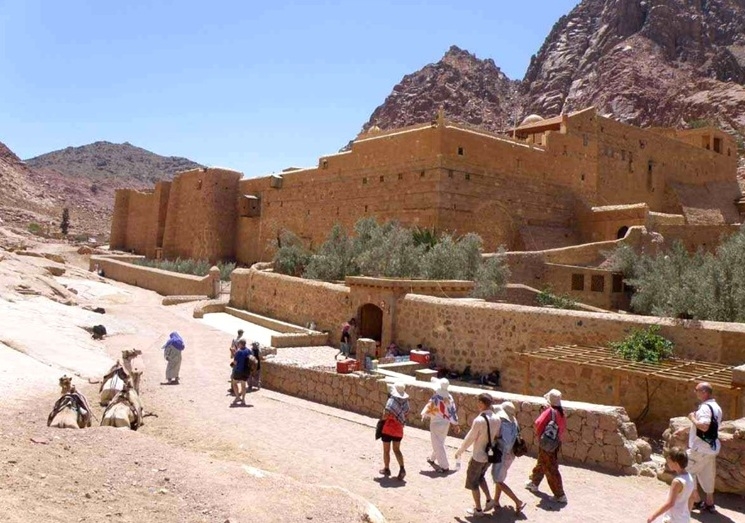
Saint Catherine’s Monastery is a historic Greek Orthodox Christian monastery located at the foot of Mount Sinai, in the South Sinai Governorate of Egypt. It is widely regarded as the oldest continuously inhabited Christian monastery in the world built for the same original purpose since its foundation in the 6th century AD.
Geographic and Religious Context
The monastery lies in a rugged, mountainous landscape at the foot of Mount Sinai — locally identified with the biblical mountain where Moses received the Torah’s Ten Commandments. This region’s spiritual importance extends across the three major Abrahamic religions: Christianity, Islam, and Judaism, granting Saint Catherine’s a unique place in religious history.
Its setting is isolated and dramatic, with the Sinai Desert’s stark beauty forming a backdrop that has inspired pilgrims, scholars, and adventurers for centuries. The remote location has contributed significantly to the monastery’s preservation and continuous monastic presence.
History
Origins and Byzantine Era
The monastery was established by the Byzantine emperor Justinian I between 548 and 565 AD to protect early Christian monks living in the Sinai and to enclose what was believed to be the Burning Bush from which God spoke to Moses.
Though there was an earlier small chapel on the site ordered by Empress Helena in the 4th century, it was Justinian’s major building program that created the fortified complex that largely survives today.
The complex was originally built in a narrow valley surrounded by protective granite walls designed to defend the monastic community from desert raiders and invaders. These walls remain largely intact.
Naming and Early Growth
Initially dedicated to the Virgin Mary, the monastery gained its familiar name after monks discovered what they believed to be the incorrupt body of Saint Catherine of Alexandria on Mount Catherine. Her relics were enshrined there, transforming the monastery into a significant Christian pilgrimage site.
Saint Catherine, martyred in the early 4th century, became one of Christianity’s most venerated saints. As devotion to her grew, so did the fame of the monastery bearing her name.
Medieval Period and Interfaith Relations
During the rise of Islam, the monastery was spared destruction in part due to diplomatic relations and a historic charter attributed to the Prophet Muhammad, which guaranteed the monastery’s protection and security. This document — known as the Ashtiname of Muhammad — is traditionally believed to grant rights and safety to the monastic community.
In the 12th century, under the Fatimid caliphate’s more tolerant rule, a Fatimid mosque was constructed inside the monastery walls, demonstrating the long tradition of peaceful co‑existence and religious harmony at the site.
By the Middle Ages, Saint Catherine’s was one of the primary centers of Christian pilgrimage in the Eastern Mediterranean and remained a bastion of learning and worship throughout centuries of change.
Architecture and Layout
Fortified Walls
The monastery’s exterior is dominated by massive granite walls rising up to 12–15 meters high, forming a fortress conspicuous in the desert valley below Mount Sinai. These walls, constructed under Justinian’s orders, are among the best surviving examples of early Byzantine defensive architecture.
The walls enclose a complex of buildings including churches, chapels, living quarters, utility spaces, and storerooms that have evolved over centuries while preserving essential original features.
Main Church: Basilica of the Transfiguration
The heart of the monastery is its Basilica of the Transfiguration, also called the Great Church or Cathedral. Built as a Roman basilica in form, it dates back to the 6th century and is oriented toward worship with centuries‑old mosaics and iconography.
The church has twelve columns symbolizing the twelve months of the year, and smaller chapels dedicated to various saints. Its interior reflects early Byzantine religious architecture with later additions and restorations amplifying its historical complexity.
Chapel of the Burning Bush
One of the monastery’s most revered sites is the Chapel of the Burning Bush, built over the location traditionally believed to be the very bush from which God communicated with Moses without consuming the plant. This sacred site is still carefully preserved and draws devout attention.
Faithful pilgrims approach the burning bush area with reverence and remove their footwear as an indication of holy ground, a tradition rooted in the biblical narrative of Moses being instructed to take off his sandals.
Fatimid Mosque and Islamic Heritage
Within the monastery walls stands a Fatimid‑era mosque, dating to 1106 AD. Its existence alongside the Christian basilica exemplifies the monastery’s historical role as a site of religious plurality and coexistence. Its mihrab and architectural details reflect the early Fatimid style.
Library and Treasure Collections
One of the monastery’s most significant contributions to world heritage is its ancient library, housing one of the most remarkable collections of early Christian manuscripts, rare books, and documents in the world.
Among the library’s treasures are ancient Greek, Arabic, and Syriac texts. Historically, the monastery held pieces of the Codex Sinaiticus, one of the earliest complete manuscripts of the Bible. Although key sections now reside in museums abroad, particularly the British Library, the monastery’s collection remains invaluable.
In the 1970s, workers accidentally discovered a trove of over 3,000 additional manuscripts hidden behind the monastery walls — many of which had been lost to scholars for centuries. These included early biblical texts, liturgical writings, and historic documents in multiple ancient languages.
Today the library’s manuscripts are among the most important collections of early Christian literature, attracting researchers and historians from around the globe.
Monastic Life and Governance
Saint Catherine’s Monastery continues today as a living monastic community under the Church of Sinai, an autonomous body within the Greek Orthodox tradition. The monastery is overseen by an abbot, who also serves as the archbishop of Sinai.
Traditionally, the monastic life follows strict ascetic practices rooted in early Christian monasticism, particularly the Basilian rule, emphasizing prayer, manual labor, and seclusion.
Despite centuries of political change around it — including the Muslim conquest, Crusades, Ottoman rule, and modern state governance — the monastery’s spiritual rhythm has remained remarkably continuous.
UNESCO World Heritage Designation
In 2002, the Saint Catherine Area — including the monastery and its surroundings — was inscribed on the UNESCO World Heritage List for its outstanding cultural and religious significance to humanity.
UNESCO recognized the site for its ancient architecture, cultural exchange between faiths, and exceptional collections of manuscripts and art, in addition to its unbroken tradition of monastic community life.
The designation emphasizes the monastery’s universal value to diverse traditions and highlights the need for careful preservation in the face of increasing tourism and environmental challenges.
Modern Developments and Preservation
In recent years, the monastery’s preservation and autonomy have been subjects of international dialogue and cooperation, notably between Egypt and Greece due to the monastery’s Greek Orthodox heritage. In 2025, both governments reaffirmed commitments to safeguard the monastery’s legal status, religious function, and cultural identity.
While discussions continue over land rights and development near the Sinai region, both nations have emphasized the importance of protecting the monastery from actions that could undermine its spiritual and historic role.
Cultural and Touristic Significance
Saint Catherine’s Monastery is not only a site of worship but also a destination for pilgrims, tourists, and scholars. Its mix of spiritual reverence, architectural significance, and historical artifacts gives visitors an immersive experience into early Christian heritage and religious coexistence.
The picturesque desert environment and proximity to Mount Sinai make the monastery a focal point for those seeking spiritual journeys, hiking expeditions to the summit of Mount Sinai, and educational tours of biblical history.
Conclusion
Saint Catherine’s Monastery stands as a testament to over 1,400 years of uninterrupted monastic tradition, spiritual devotion, cultural exchange, and historical preservation. From its Byzantine foundations to its current status as a UNESCO World Heritage site, the monastery continues to inspire awe and respect across religions and cultures.
Explore more about Saint Catherine’s Monastery on Wikipedia and deepen your understanding of its global cultural significance, rich manuscript heritage, and enduring spiritual legacy.